Three Shifts for Redesigning an Enterprise System of Work for AI
Updated: 1 day ago
AI is moving fast. Really fast. But in many organisations, the way work moves from an idea to actual value still feels slow.
AI can speed up analysis, design, coding, testing and evidence creation. But if the output then sits in a queue, waits for the next governance forum, or gets passed through another manual hand-off, a lot of that potential disappears.
The pattern we keep seeing is that the technology is accelerating, but the system of work around it often isn't. So, the real bottleneck may no longer be the AI capability itself. It may be the operating model it has to move through.
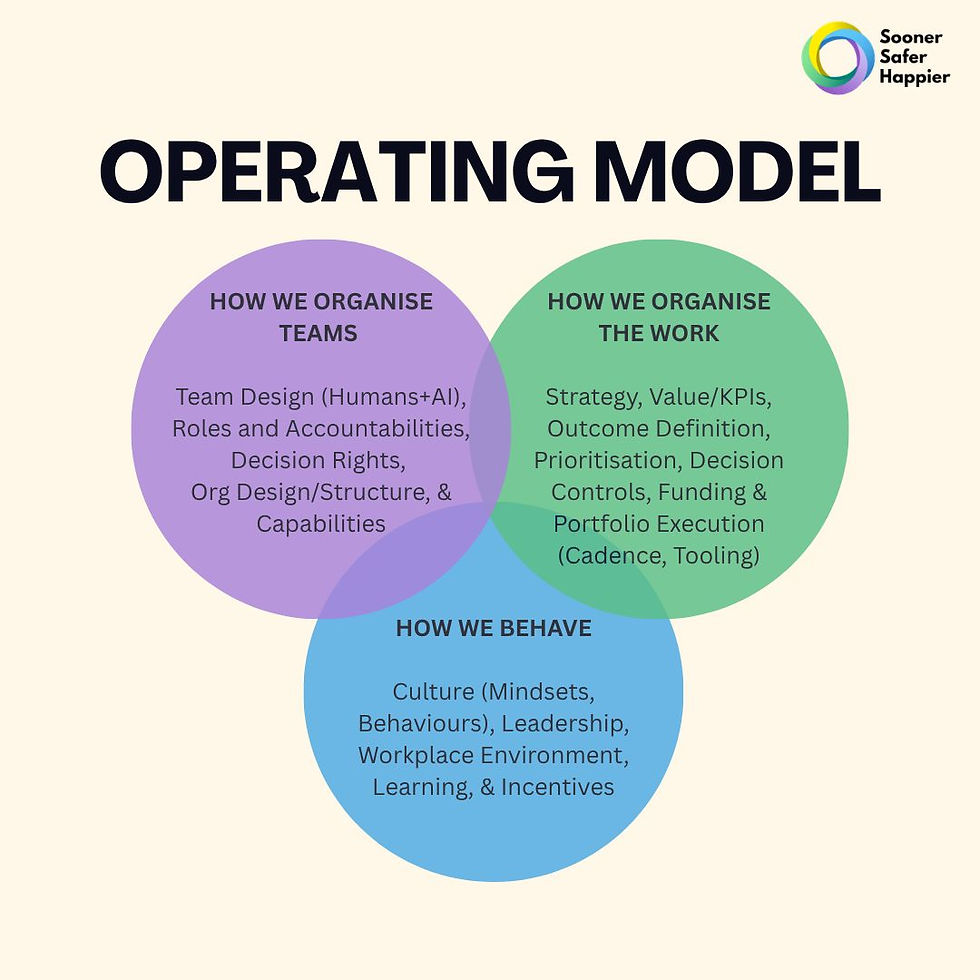
In recent work redesigning an enterprise system of work for AI, three shifts really stood out:
Governance needs to move from approval gates to controls and evidence built into the flow.
Teams need to move from fixed human capacity to broader capability ecosystems.
Planning needs to move from periodic events to a more continuous system.
The Governance Shift: Embedding Control
Governance shifts from flow to embedded

AI is making existing enterprise constraints more visible, and delivery governance is a great example. Delivery governance exists for good reasons. Policies, standards, controls and guardrails help us manage risk and make sound decisions, but too often governance has been designed as a sequence of stop signs. Work progresses, then steps out of the flow for approval. Evidence is assembled manually. A forum is scheduled. Questions come back. The work enters another queue.
The issue isn't governance itself. It's where and how it happens.
AI gives us the opportunity to redesign and move governance from approval gates to controls and evidence built into the flow. Guardrails can be visible from the start. Evidence can be generated continuously. Routine checks can happen automatically. Exceptions can be surfaced earlier.
That also changes where human judgement is needed:
Pre-approved: work proceeds inside known guardrails.
Human-in-the-loop: someone makes a material judgement, supported by evidence.
Forum by exception: unusual risk, uncertainty or deviation is escalated.
This isn't about reducing accountability or allowing AI to approve everything. Done properly, it means clearer decision rights, earlier control and better evidence.
A practical starting point is to pick one high-friction control point and redesign adherence, so it happens within the flow, not around it. That is the governance shift: stronger assurance with less friction.
The Team Shift: Building Capability Ecosystems
Team model shifts from capacity to capability ecosystems

For a long time, team design has meant matching people and skills to demand, but with human capacity usually the central constraint. Agentic AI has already started to change that - the useful unit of design is becoming less about fixed roles and more about a capability ecosystem built around the outcome.
That ecosystem can include people, systems, agents and token-based compute.
People bring purpose, judgement and accountability.
Systems provide workflow, data and control.
Agents add scalable capability to analyse, generate, coordinate and act.
Tokens make compute a visible resource with an economic cost that needs to be allocated to value.
That leads to a different leadership question. Instead of asking, "How many people do we need, and what roles?", we can ask, "What combination of human and AI capability gives us the best way to achieve this outcome?"
That doesn't make the human roles less important. It makes us more explicit about where human judgement remains central, what agents can do, when they escalate and who remains accountable.
The opportunity isn't simply to make today's roles more productive. It is to rethink the team around the outcome.
The Planning Shift: From Periodic to Continuous
Planning shifts from periodic to continuous

AI is exposing a planning system that still runs on fixed cycles. Strategy is set, funding is allocated and roadmaps are agreed. Then reality changes. New evidence appears, customer needs move or risks shift. But too often, the organisation must wait for the next planning event before it can respond.
AI starts to challenge that model when signals can be gathered continuously, options explored quickly and evidence connected back to outcomes. Planning can become a more continuous system of reflecting, adapting, aligning and acting.
That doesn't mean changing strategy every week. Long-term intent still provides direction. But priorities, investment and capacity can adjust as evidence changes, rather than waiting for the calendar to catch up.
For that to work, the connections need to be visible. Strategy to outcomes. Outcomes to work. Work to evidence. Evidence back to decisions. That golden thread is what allows an organisation to adapt without simply creating more churn.
Conclusion
We believe that the next phase of AI advantage won’t go to the organisations with the longest list of use cases. The bigger Strategy to Execution opportunity will go to the organisations that can learn quickly, make good decisions sooner, and turn those decisions into value safely and at scale.
The questions you might ask to help this are:
Where does work spend more time in your organisation: being worked on, or waiting?
How much of your governance actively guides the work while it is happening, rather than checking it afterwards?
If you were designing your teams from scratch today, how different would they look?
How quickly can your organisation turn new evidence into a change in priorities, investment or action?