What is an Operating Model?
As organisations rethink how work gets done, particularly in the context of AI, operating model design is becoming even more important. But too often the conversation still starts and ends with structure: roles, reporting lines and boxes.
Changing an operating model isn't simply a restructure. It's about how the organisation works as a system: how teams are organised, how the work is organised, and how people behave and lead.
For almost 10 years, I've used these 3 interconnected circles as a simple way to describe what an operating model is.
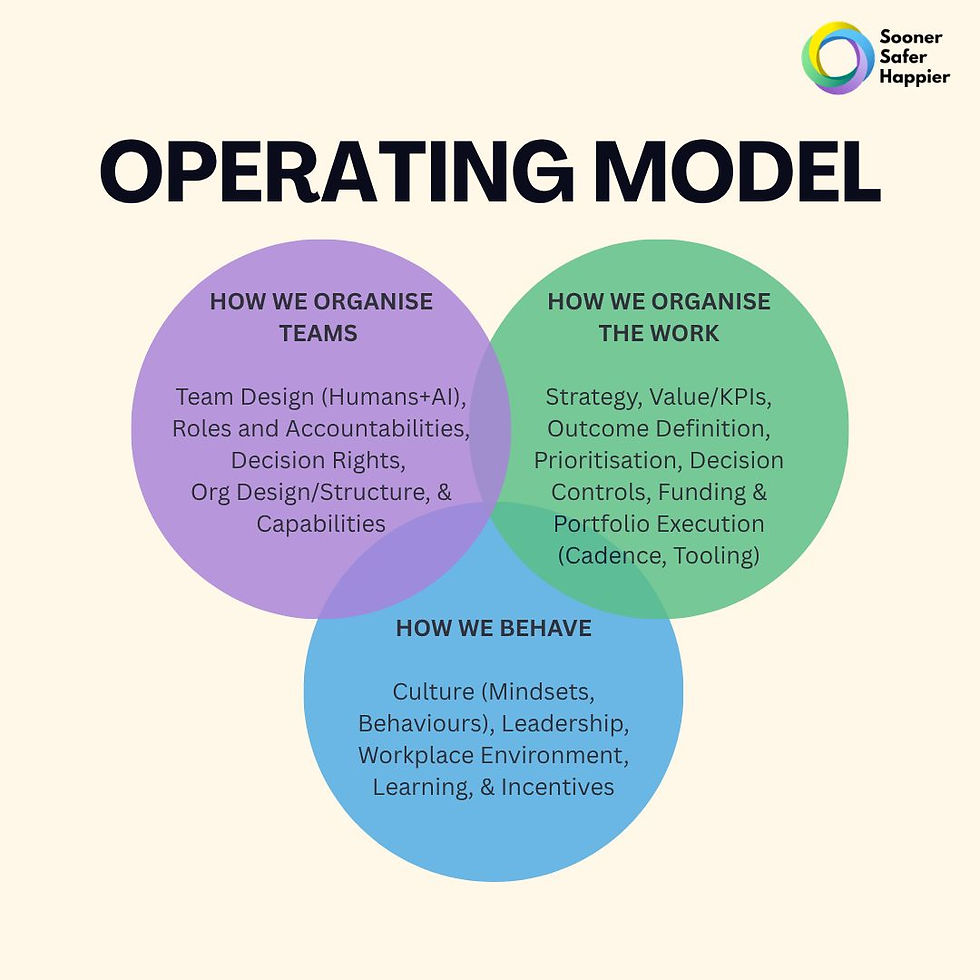
The mistake I see time and time again is organizations' treating these as separate problems.
⚠️ They redesign structures but leave governance, funding and prioritisation unchanged.
⚠️ They introduce new processes and tools but don't shift leadership behaviours or incentives.
⚠️ They invest in culture but don't address the system people are working within.
This approach 🟰 Friction. People are asked to behave in ways that the system doesn't support.
Today, AI is making this even more apparent. Many organisations are focused on AI tools and use cases. But AI isn't just a technology change. It is an operating model change.
To unlock value from AI, all three circles need to evolve together:
🟣 How we organise teams
🟢 How we organise the work
🔵 How we behave
AI won't just change how work gets done. It will challenge how organisations are designed to operate.
The leaders who rethink how they organise teams, organise work, and shape behaviours will create the conditions for AI to deliver real value.
Because an operating model is a system. And systems only improve when all the parts move together.


